

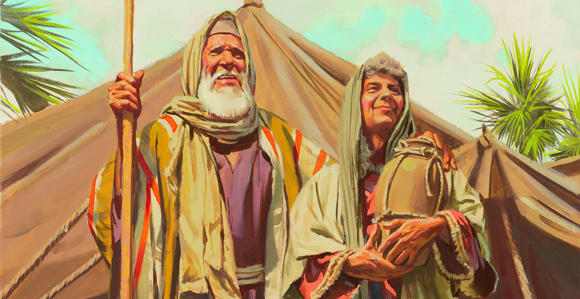
Indeed, the Abraham and Sarah Story is one of the most powerful and deeply human narratives in the Bible. It illustrates waiting, doubt, hope, and ultimately, fulfilled promise.
As a narrative, it invites reflection on commitment, doubt, and trust, showing how divine timing intersects human longing. The story remains instructive for believers and scholars alike, offering a model of perseverance, communal waiting, and the faith that sustains hope when outcomes seem distant.
If you have ever wondered why God delays, the Abraham and Sarah Story speaks directly to you. Additionally, if His promises truly come to pass, this story also speaks to you.
Background of Abraham and Sarah
Abraham, originally called Abram, lived in a time when people worshiped many gods.
This moment marks the Abraham and Sarah Story.
However, God chose him for a special purpose.
Ultimately, God made a life-changing promise to Abraham:
- He would become the father of a great nation
- His descendants would be countless
- Through him, all nations would be blessed
There was just one problem.
Abraham and Sarah had no children, and they were already old.
Sarah, whose name was originally Sarai, struggled deeply with this reality. Additionally, in that culture, childlessness brought emotional pain and social shame.
God’s Promise Tested by Time in the Abraham and Sarah Story
Years passed. Additionally, decades.
Nevertheless, still no child.
Abraham was around 75 years old when God first gave the promise. As time went on, both Abraham and Sarah began to wrestle with doubt.
Sarah, in her frustration, made a decision. However, she tried to “help” God.
She gave her servant Hagar to Abraham so they could have a child through her. As a result, this led to the birth of Ishmael.
However, this was not God’s plan.
This part of the story shows something very real.
Additionally, even strong believers can lose patience and make emotional decisions.
God Reaffirms His Promise
Despite their mistakes, God did not abandon them.
Nevertheless, He remained with them.
Instead, He reaffirmed His promise.
- Abram’s name was changed to Abraham, meaning “father of many nations”
- Sarai’s name was changed to Sarah, meaning “princess”
- God promised that Sarah herself would give birth to a son
However, when Sarah heard this, she laughed.
Nevertheless, it was not joy, but disbelief.
She thought it was impossible. Moreover, after all, she was around 90 years old.
However, God responded with a powerful truth.
Indeed, is anything too hard for the Lord?
The Birth of Isaac – Promise Fulfilled
Additionally, at the appointed time, exactly as God said, Sarah gave birth to a son in the Abraham and Sarah Story.
Thus, they named him Isaac, which means “laughter.”
Thus, this time, Sarah’s laughter was no longer a doubt—it was joy.
Thus, God fulfilled His promise, not early, not late, but exactly on time.
Key Lessons from Abraham and Sarah’s Story
God’s Timing Is Not Human Timing
We often expect quick results. However, God works on a different timeline.
Moreover, Abraham and Sarah waited decades, yet God remained faithful.
2. Doubt Does Not Cancel God’s Promise
Firstly, they doubted. Moreover, they made mistakes.
Thus, God fulfilled what He promised.
However, this is important — your moment of weakness does not erase God’s plan.
3. Trying to Control God’s Plan Leads to Trouble
Sarah’s decision involving Hagar created long-term conflict.
Additionally, when we rush ahead of God, we often create unnecessary problems.
4. Nothing Is Impossible for God
However, a 90-year-old woman giving birth is humanly impossible.
This remains outside natural biological possibility.
Nevertheless, with God, limitations do not exist.
Spiritual Meaning of the Story
The story of Abraham and Sarah is not just historical.
Moreover, it is deeply spiritual.
As a result, it reflects the following points.
- Faith in uncertainty
- Trust during long waiting periods
- God’s faithfulness even when humans fail
Thus, it reminds us that God’s promises are not based on human ability, but on His power.
Conclusion
Ultimately, the Abraham and Sarah Story is a story of hope.
Additionally, it teaches us that.
- Waiting is not wasted time
- God’s promises never fail
- Even when we doubt, God remains faithful
If you are in a season of waiting right now, this story is for you.
Moreover, it speaks to that space you are in.
God has not forgotten you.
Nevertheless, he is working—even when you cannot see it.